Biography
Ian Hornak (1944–2002)
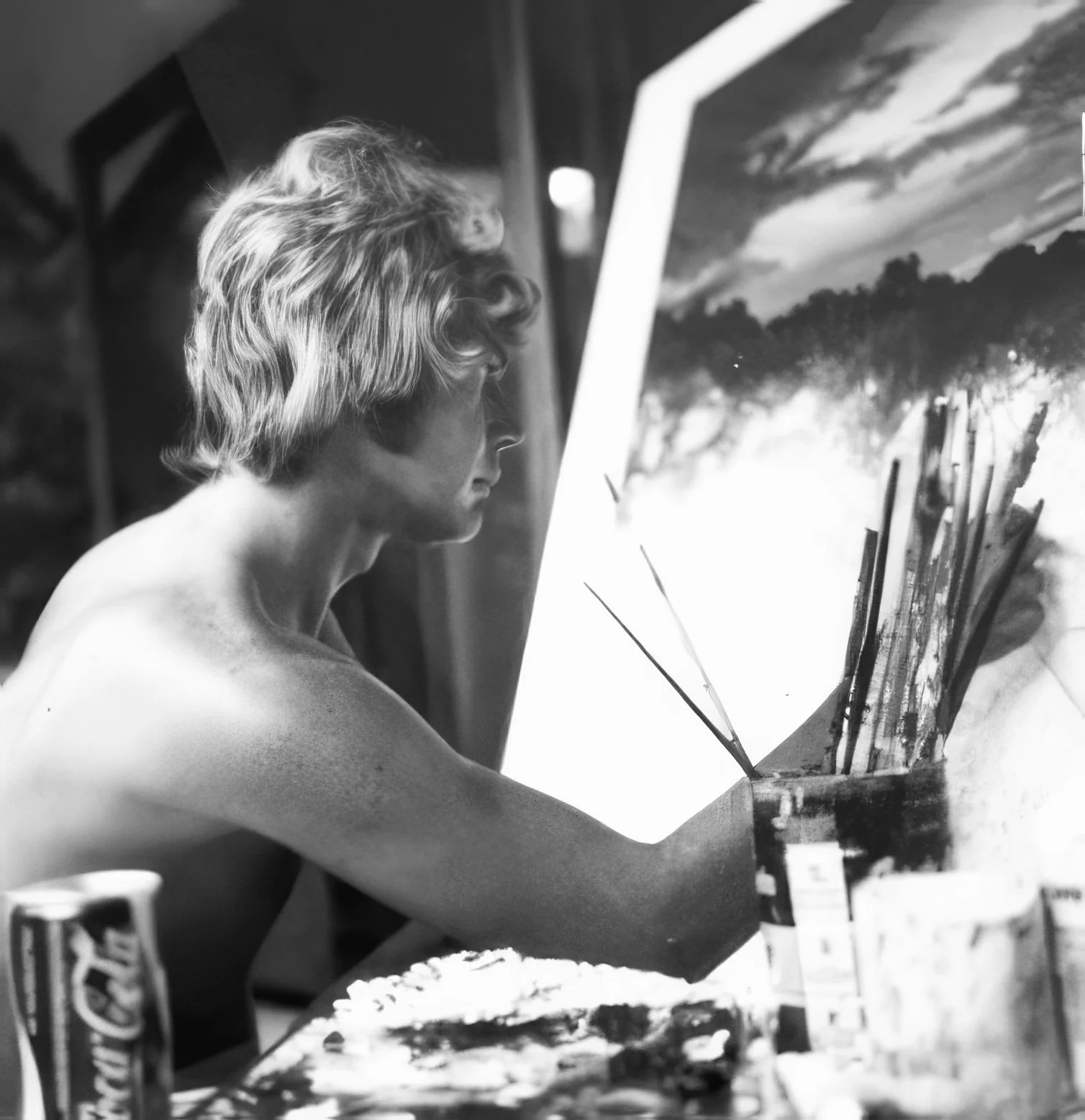
Ian Hornak was an American painter, draftsman, and printmaker whose work occupies a distinctive place in the history of late twentieth-century American realism. Combining the technical precision of Photorealism with the atmosphere of Romanticism and the symbolism of earlier European traditions, Hornak developed a highly personal visual language that evolved over four decades and established him as one of the most original voices in contemporary representational painting.
Born in Philadelphia, Pennsylvania, on January 9, 1944, Hornak was raised in the metropolitan Detroit area and displayed artistic ability from an early age. Fascinated by the Renaissance masters, nineteenth-century landscape painting, and photography, he pursued formal studies at Wayne State University, where he earned both bachelor’s and master’s degrees in fine arts and later taught drawing. During these years he consciously turned away from the prevailing dominance of abstraction, choosing instead to devote himself to representational painting.
In 1968 Hornak relocated to New York City, where he entered the vibrant artistic community surrounding Lowell Nesbitt and soon became acquainted with many of the leading figures of the period. Following the closing of Eleanor Ward’s legendary Stable Gallery, Lee Krasner introduced Hornak to Tibor de Nagy Gallery, which became his New York representative and presented his first solo exhibition in 1971.
Hornak first gained recognition for his atmospheric landscapes, many of which were assembled from numerous photographic studies and infused with literary, historical, and mythological references. Unlike many Photorealists, whose work focused on mechanical accuracy alone, Hornak sought to create emotional and symbolic narratives. Critics frequently noted that his paintings possessed qualities more closely aligned with Romanticism and Symbolism than with strict Photorealism. Throughout the 1970s and early 1980s he produced a series of increasingly ambitious landscape paintings whose titles referenced figures from Greek mythology and classical literature, including Persephone, Eurydice, Iphigenia, and Asmodeus.
As his career progressed, Hornak expanded his compositions beyond the traditional boundaries of the canvas by creating elaborate hand-painted frames that became integral parts of the paintings themselves. By the late 1980s he turned increasingly toward floral and still-life subjects inspired by seventeenth-century Dutch and Flemish painting. These luminous works, characterized by extraordinary detail and complex symbolic content, would occupy the final years of his career and become some of his most celebrated images.
Throughout his lifetime Hornak produced approximately 1,400 paintings. His work was exhibited extensively in New York and throughout the United States and entered numerous public and private collections. Institutions associated with his work include the Smithsonian American Art Museum, the Corcoran Gallery of Art in Washington, D.C., the Detroit Institute of Arts, the Indianapolis Museum of Art, and many university and regional museum collections.
John Canaday of The New York Times described Hornak in 1974 as being “right at the top of the list of romantically descriptive painters today,” while later critics observed that his work bridged realism, symbolism, and mythology in ways unlike those of his contemporaries. Newspaper reviews and national obituary notices frequently referred to him as one of America’s leading hyperrealist painters, yet Hornak himself resisted labels and remained committed to creating paintings that transcended stylistic categories.
Ian Hornak died in Southampton, New York, on December 9, 2002, at the age of fifty-eight. Since his death, his work has been the subject of museum exhibitions and scholarly reassessment, including the retrospective Transparent Barricades presented by the Board of Governors of the Federal Reserve System in Washington, D.C. His paintings continue to attract collectors, scholars, and museums, and today he is recognized as an important figure in the evolution of American realism—a painter who combined technical mastery with symbolism, mythology, and a deeply personal vision of nature.
Selected Collections
Smithsonian American Art Museum, Washington, D.C.
Smithsonian National Museum of American History, Washington, D.C.
Smithsonian National Portrait Gallery, Washington, D.C.
Smithsonian Archives of American Art, Washington, D.C.
Library of Congress, Washington, D.C.
Board of Governors of the Federal Reserve System, Washington D.C.
Museum of Fine Arts Boston, Massachusetts
Detroit Institute of Arts, Michigan
Corcoran Gallery of Art, Washington, D.C.
Ringling College of Art and Design, Florida
Dartmouth College, Hood Museum of Art, New Hampshire
Vassar College, Frances Lehman Loeb Art Center, New York
George Washington University Art Galleries, Washington D.C.
Rutgers University, Jane Voorhees Zimmerli Art Museum, New Jersey
Guild Hall, East Hampton, New York
Florida State Capitol Complex
National Hellenic Museum, Illinois
National Czech and Slovak Museum, Iowa
Numerous university, corporate, and private collections throughout the United States